
Ramadan Day 15

We’re past the midway point of Ramadan, and I imagine I’m not the only one wondering where the first half of the month went. The days have moved slowly in the moment but somehow also quickly in retrospect. It’s interesting how time can be so stretchy depending on the context.
The chaos and violence of the world weigh heavily on those of us with a conscience, and I know that many of us are finding it hard to know how to balance our everyday life with witnessing what is going on in the world. I am finding my refuge on my prayer mat more than usual these days. Du’as can be a powerful medicine when we feel helpless and ineffective.
Despite a pounding headache that felt like a gigantic hand was squeezing much of my head, I still managed to go for a stroll in the neighborhood and see what I could notice. Spring in Northern California can be glorious, with perfect weather, blooming flowers and trees, and stunning blue skies. Alhamdulillah.
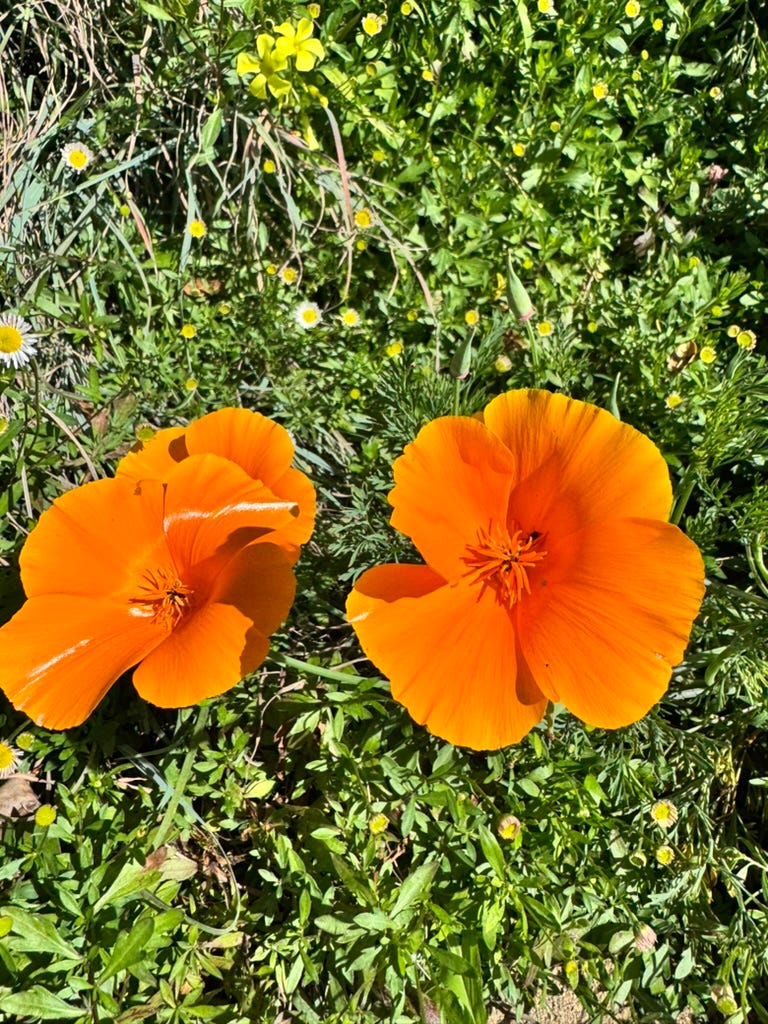
Seeing California poppies in their full majesty brought a big smile to my face. The way they grow everywhere like weeds, yet they are the state flower, so they’re somehow regal. Stunning and resilient, they are definitely my favorite flower native to this region.
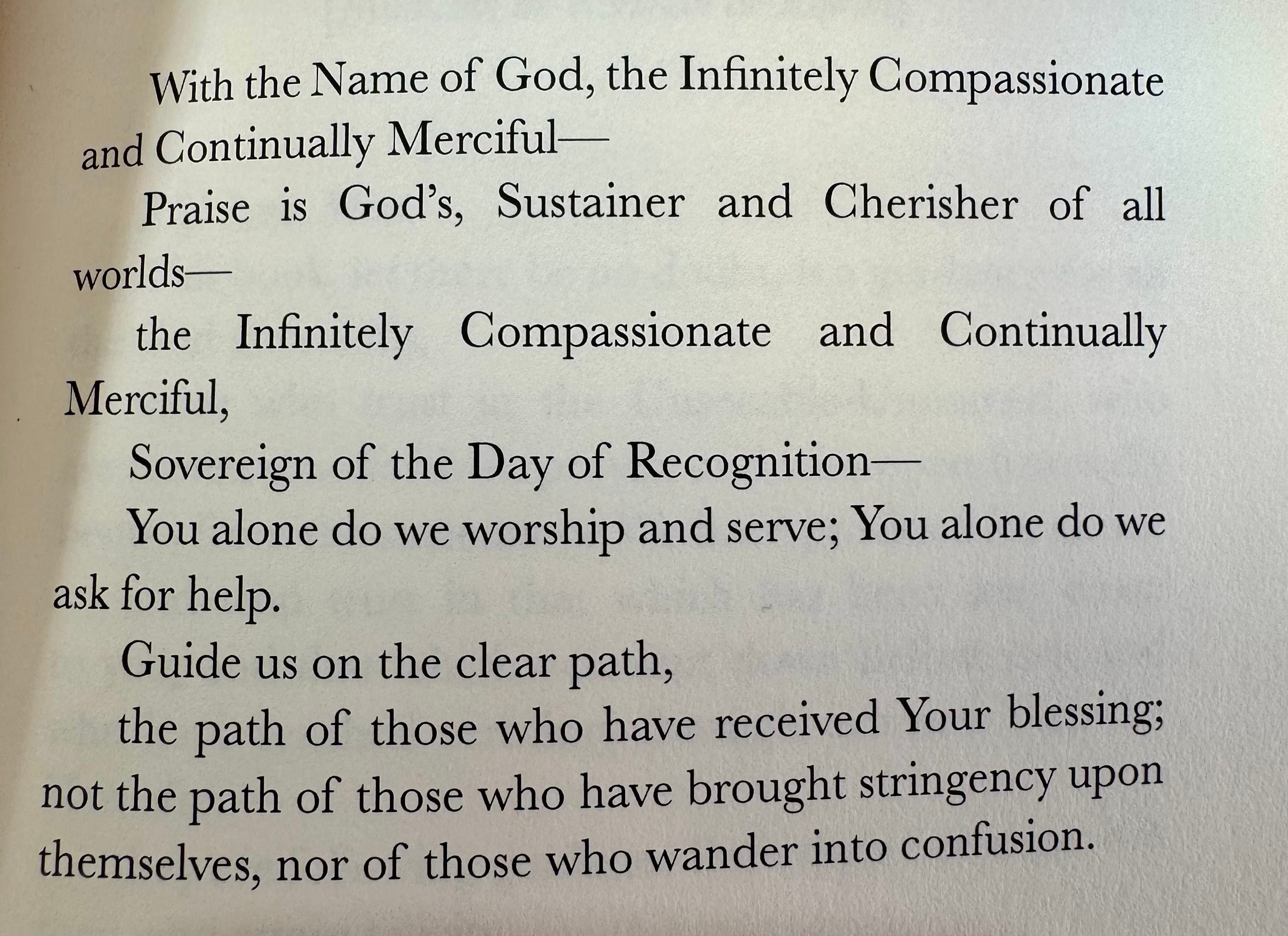
Tonight in the Rahma Ramadan Circle, I brought a newer translation by Camille Helminski (link here) to reflect on together. Lately I’ve felt the need to slow down with things that are common in our everyday lives, to give them a closer read. We had been using a different translation of the Fatihah to open our sessions, but I wanted to bring in a fresh perspective.
Now, of course, all translations are just interpretations, and each one brings with it the subjective biases, worldview, and interpretations of the translator. This translation is no exception, but Helminski is clearly trying to make the Qur’an accessible to English readers on multiple levels, including its formatting without verse numbers to make it more readable, and introducing new ways of thinking about verses that many Muslims recite multiple times throughout the day without contemplating their meanings deeply enough.
Back when I taught about Islam to university students, I enjoyed teaching courses on the Qur’an. My favorite days were when we would bring many different translations of the same verses and consider the differences in meaning between them. It can be striking to see how many ways there are to interpret the same passages, giving non-Arabic speakers a glimpse into the depth of the Arabic language and the Qur’an itself.
I’ll leave Helminski’s translation here on its own without my commentary, as I’ve reached the end of my capacity for today. While I would translate it differently, I do appreciate her attempt at liberating the Qur’an from a much harsher approach that can be common in various other translations.
I’d love to hear how this translation lands with you, and what you notice about it that offers a different way of understanding the Fatihah.
This is a fascinating translation. It’s like she’s bringing out a kinder reading, “jamal-focused” to balance out the more typical “jalal-focused” approach.
Very interesting to render رب as “Sustainer and Cherisher”. I like the reminder that one who is in charge doesn’t have to be domineering, that responsibility can be executed in a caring way. It’s not how I’d normally translate the word, but I’ll take it.
I’m less sold on مستقيم as “clear”. I can appreciate that the right path can seem meandering rather than straight… but what’s right isn’t always clear and obvious either? Or perhaps she meant “clear” more like “pure” or “luminous”, the Path of Light vs the Path of Darkness or somesuch?
Anyway, thanks for sharing. More broadly, I’ve really been enjoying your posts! As someone who is both missing community and discovering a spiritual side to going out into nature this Ramadan, what you’re writing really resonates.🌷
Love you, Rose, for your soul, your work, and your writing. 🌹